

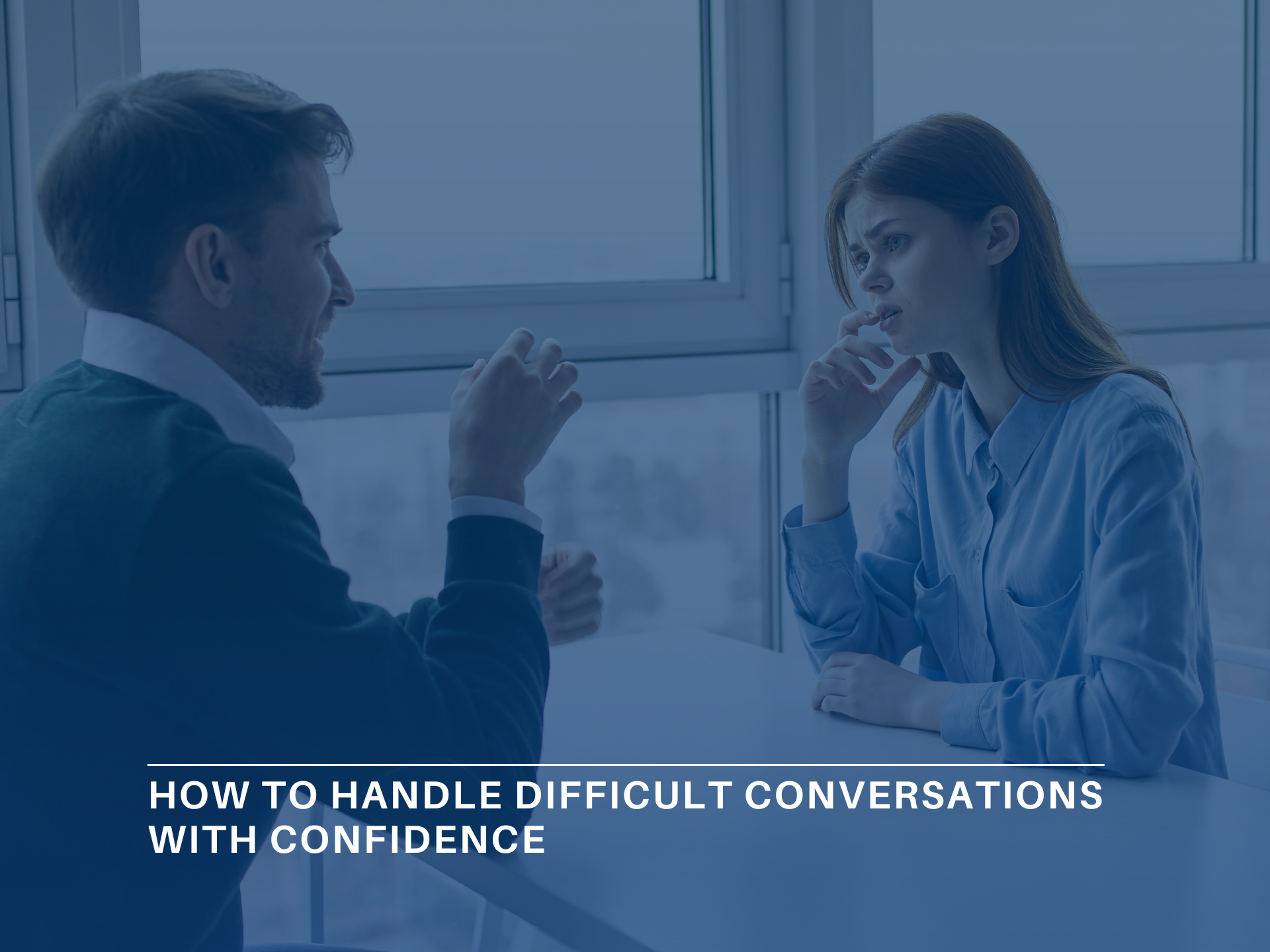
18 Jun How to Handle Difficult Conversations with Confidence
You can see it happen in real time. A manager reads a blunt Slack message, types a reply, deletes it, and decides to “circle back later”. Or they rehearse tough feedback for days, only to soften it so much it loses meaning. The issue isn’t that people can’t communicate, but that they hesitate, overthink and dilute what needs saying. In today’s fast-moving, feedback-heavy workplaces, difficult conversations aren’t rare moments of drama, they are a core operating skill. Avoiding them carries a cost: slower decisions, muddled accountability, and a culture of quiet frustration rather than honest progress. So, how to handle difficult conversations…..? Let’s investigate.
What Actually Makes a Conversation “Difficult
What actually makes a conversation “difficult”? It is rarely just conflict or emotion. More often, it is uncertainty. You do not know how your words will land, whether you are risking someone’s confidence, or even your own reputation. Tell a high performer their results are slipping and you are not just discussing numbers, you are challenging identity. Raise concerns with a senior colleague and hierarchy suddenly matters. Then there is the modern twist. Slack threads, delayed replies and unread emails quietly build tension before anyone speaks. In hybrid work, silence can feel louder than disagreement. Research from Harvard Business Review highlights that perceived psychological risk, not topic, drives avoidance. In other words, difficulty is less about what you say and more about the uncertainty surrounding it. That is why even simple conversations can feel unexpectedly loaded.
Say the Hard Thing
“Say the hard thing” sounds heroic, but in reality it is rarely one dramatic moment. Courage at work is better understood as a repeatable micro-skill rather than a fixed personality trait. Effective leaders do not wait for tension to build or problems to become unavoidable. They step in early with small, direct truths. A manager who says, “That presentation missed the client brief, let’s fix it,” avoids a far tougher conversation later about lost business, damaged trust, or declining performance. This is micro-bravery in action, and it compounds over time.
The real danger is delayed honesty. The longer you wait, the more emotionally charged and complex the issue becomes, often distorting the message entirely. Research from McKinsey & Company shows that timely, candid feedback is strongly linked to higher team performance, yet many leaders still hesitate.
Modern leadership demands emotional precision, not vague transparency. One practical tool is the One-Sentence Truth Test. If you cannot express the issue clearly in a single sentence, you are not ready to say it with confidence.
From Tension to Trust: Reframing Conflict as a Growth Engine
Most people assume conflict damages relationships. In reality, it often does the opposite. Trust is not built by avoiding tension but by working through it constructively. Research shows that teams who engage with disagreement openly tend to be more resilient, innovative and aligned over time.
High-performing teams treat conflict as data, not drama. When a product lead challenges a marketing plan or a colleague questions a deadline, the goal is not to win an argument but to surface what might be missing. The most effective conversations do not simply resolve tension in the moment. They upgrade how people work together in the future.
A practical approach makes this easier. First, acknowledge the friction so it is out in the open. Then explore different perspectives without rushing to defend your position. Finally, rebuild clarity around roles, expectations and next steps. Used well, tension strengthens trust. Avoided, it quietly weakens it.
The Confidence Code for Confrontation
Confident confrontation is not a soft skill. It is a competitive advantage. Leaders who handle conflict well increase decision speed and reduce costly ambiguity. In fast-moving organisations, hesitation is expensive. Clarity and rapid decision-making are closely linked to performance, yet many leaders still avoid direct conversations.
Psychological safety is often misunderstood. It is not about comfort or avoiding offence. It is about confidence in honest dialogue, even when it feels uncomfortable. The real shift is this; confidence does not come from personality. It comes from structure.
A simple approach works. Start with clarity about the issue. Add context so the timing makes sense. Explain the consequence so it matters. Then invite curiosity by asking for the other perspective. A team leader addressing missed deadlines might say exactly that, rather than hinting or softening the message. Great leaders do not avoid confrontation. They design it carefully so it moves things forward.
No More Walking on Eggshells
Most workplace conflict is not dramatic. It is low-grade, repetitive friction that quietly drains energy and performance. A colleague consistently misses deadlines. A manager’s tone in meetings shuts people down. Expectations drift across teams until frustration builds. These are the moments people avoid, yet they are the ones that matter most. Research shows that unaddressed minor tensions often escalate into larger organisational problems.
People do not walk on eggshells because they are kind. They do it because the culture punishes honesty. That is where the shift needs to happen.
Practical tactics help. Drop the old feedback sandwich and say what you mean, clearly and respectfully. Address issues in real time rather than storing them up for performance reviews. Be specific. Replace “You always interrupt” with “In that meeting, you spoke over Sarah twice.” A team leader handling cross-cultural misunderstandings might clarify expectations openly instead of hinting. Done well, these small interventions prevent bigger problems later.
Disagree Better
High-performing teams are not the ones with the least conflict. They are the ones that handle disagreement without turning every meeting into passive-aggressive theatre. The smartest organisations now treat constructive conflict as a competitive advantage, not a management failure. A growing body of research on psychological safety shows that teams perform better when people feel able to challenge ideas openly without fear of humiliation or political fallout. That is why many firms now build “structured dissent” into meetings. One senior executive is deliberately assigned the role of challenger. Others run pre-mortems, asking “What could cause this strategy to fail six months from now?” before decisions are signed off. Pixar famously encourages brutally honest creative feedback early in development rather than polite silence followed by expensive disaster.
Simple language also matters. Phrases such as “I see it differently” or “What are we missing?” lower defensiveness immediately. In modern business, the ability to disagree intelligently is becoming just as valuable as the ability to decide quickly.
Confidence Is Built, Not Born
Nobody glides effortlessly through difficult conversations. Confidence is not a personality trait handed out at birth. It is a skill built through repetition, preparation and the occasional uncomfortable meeting that does not go perfectly. The real shift happens when people stop avoiding tension and start designing conversations with intent. Great managers do not simply react when conflict appears. They ask better questions, listen harder and stay curious instead of defensive. Research from Crucial Conversations and the Harvard Business Review repeatedly shows that teams with open communication solve problems faster and make better decisions under pressure.
In a workplace shaped by constant disruption, the winners will not be the people who dodge hard conversations. They will be the ones who use them to think sharper, move faster and lead with far greater impact.
And what about you…?
• How comfortable are you with disagreement at work? Do you see it as a threat, or as a sign that people are genuinely engaged?
• If colleagues described your communication style during difficult conversations, would they say you create clarity and trust, or caution and avoidance?
Related Training Programmes
Related Training Programmes