

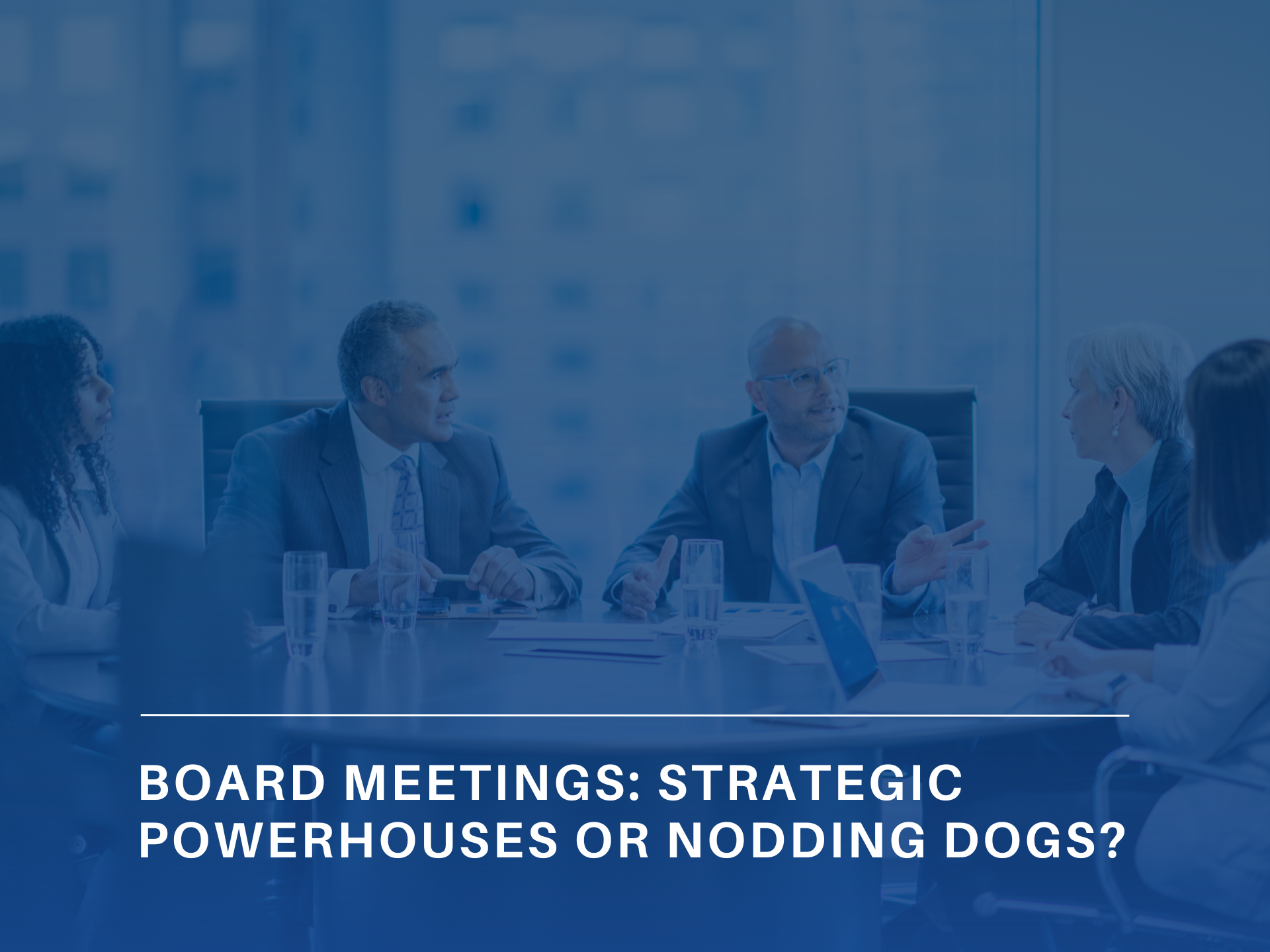
Board Meetings: Strategic Powerhouses or Nodding Dogs?

Picture this: A room filled with seasoned professionals, each with a wealth of expertise and insight, gathered to steer the future of an organisation. It’s a scene ripe with potential for robust discussions, innovative ideas, and strategic breakthroughs. But now imagine those same individuals nodding in silent agreement, their roles reduced to mere formality, their presence offering little more than decorative support. This is the stark contrast between effective board meetings and what has been coined the “nodding dog syndrome.” The phrase brings to mind the iconic car dashboard accessory - a bobble-headed dog nodding in rhythm with the road. While amusing in a vehicle, this passive behaviour in a boardroom can lead to missed opportunities, unchallenged decisions, and, ultimately, organisational failure. Effective governance demands much more than quiet acquiescence. It requires a board that acts as a critical strategic partner, driving an organisation forward with purpose and precision. Governance Lives in the Boardroom Good governance is not an abstract concept—it lives and breathes in the boardroom. Regular board meetings are the nerve centre where decisions are made to ensure legal compliance, operational effectiveness, and long-term sustainability. Simone Joyaux, a respected consultant in governance and strategic planning, puts it succinctly: “The board does governance at its meetings. In fact, the only time that governance happens is when the board convenes at its meetings.” Yet, despite this pivotal role, many board meetings fail to harness the collective potential of their members. Instead of vibrant discussions, they become routine rituals where agendas are ticked off and decisions pass unchallenged. The results? Strategic stagnation and, in worst-case scenarios, organisational collapse. The Risk of Nodding Dog Syndrome Behind many high-profile corporate failures lies a troubling pattern: board members who failed to question decisions, challenge assumptions, or offer alternative perspectives. They nodded along, allowing flawed strategies to proceed unchecked. The “nodding dog syndrome” poses a significant threat to any organisation. But how does a board avoid falling into this trap? It starts by creating the right conditions for effective, engaged meetings. Transforming the Boardroom: From Passive to Proactive To transform a boardroom from a passive setting into a dynamic hub of strategic decision-making, certain elements must be in place. Here’s how successful boards operate: • Every effective meeting starts with a well-crafted agenda. Key issues should be prioritised with decisions and outcomes clearly outlined in advance. • Members must receive concise yet comprehensive information well ahead of the meeting. This enables them to arrive prepared and ready to contribute meaningfully. • Strategic issues require fresh minds and sharp focus. Address these earlier in the meeting, leaving routine matters for later. • Consistent participation is non-negotiable. Minimum attendance rates ensure that members are actively involved throughout the year. • Discussions should lead to actionable decisions. Responsibilities must be assigned, and a follow-up process ensures implementation. • Meetings need structure and discipline. Irrelevant arguments or rambling presentations have no place in a productive boardroom. • The best decisions come from diverse viewpoints. All members should feel encouraged to share their perspectives, avoiding dominance by a few voices. The Chairperson: The Boardroom Conductor Central to the success of any board meeting is the chairperson. Much like a conductor directing an orchestra, the chairperson ensures harmony, focus, and effectiveness. The European Banking Authority Guidelines (2018) emphasise this role, stating: “The chair should set meeting agendas and ensure that strategic issues are discussed with priority. He or she should ensure that decisions of the management body are taken on a sound and well-informed basis.” The chairperson’s responsibilities include: • To create a safe space for open discussion and ensure that all voices are heard. They should welcome tough questions and encourage diverse perspectives. • To ensure the board adheres to governance codes and best practices, maintaining its focus on oversight and strategy. • To remain distinct from the CEO, acting as a critical friend who supports and challenges in equal measure. The Final Word: Building Better Boards Board meetings are not a box-ticking exercise—they are the beating heart of governance. By fostering a culture of active engagement, rigorous preparation, and open dialogue, organisations can unlock the full potential of their boards. Don’t let your board become a group of nodding dogs. Instead, build a team of strategic partners ready to challenge, contribute, and drive your organisation toward a sustainable and successful future. After all, as noted before, in the words of Simone Joyaux, governance happens in the boardroom—so let’s ensure it happens well.

Board Meetings: Strategic Powerhouses or Nodding Dogs?

Picture this: A room filled with seasoned professionals, each with a wealth of expertise and insight, gathered to steer the future of an organisation. It’s a scene ripe with potential for robust discussions, innovative ideas, and strategic breakthroughs. But now imagine those same individuals nodding in silent agreement, their roles reduced to mere formality, their presence offering little more than decorative support. This is the stark contrast between effective board meetings and what has been coined the “nodding dog syndrome.”

The phrase brings to mind the iconic car dashboard accessory – a bobble-headed dog nodding in rhythm with the road. While amusing in a vehicle, this passive behaviour in a boardroom can lead to missed opportunities, unchallenged decisions, and, ultimately, organisational failure. Effective governance demands much more than quiet acquiescence. It requires a board that acts as a critical strategic partner, driving an organisation forward with purpose and precision.


Governance Lives in the Boardroom

Good governance is not an abstract concept—it lives and breathes in the boardroom. Regular board meetings are the nerve centre where decisions are made to ensure legal compliance, operational effectiveness, and long-term sustainability. Simone Joyaux, a respected consultant in governance and strategic planning, puts it succinctly: “The board does governance at its meetings. In fact, the only time that governance happens is when the board convenes at its meetings.”

Yet, despite this pivotal role, many board meetings fail to harness the collective potential of their members. Instead of vibrant discussions, they become routine rituals where agendas are ticked off and decisions pass unchallenged. The results? Strategic stagnation and, in worst-case scenarios, organisational collapse.


The Risk of Nodding Dog Syndrome

Behind many high-profile corporate failures lies a troubling pattern: board members who failed to question decisions, challenge assumptions, or offer alternative perspectives. They nodded along, allowing flawed strategies to proceed unchecked. The “nodding dog syndrome” poses a significant threat to any organisation.

But how does a board avoid falling into this trap? It starts by creating the right conditions for effective, engaged meetings.


Transforming the Boardroom: From Passive to Proactive

To transform a boardroom from a passive setting into a dynamic hub of strategic decision-making, certain elements must be in place. Here’s how successful boards operate:

  • Every effective meeting starts with a well-crafted agenda. Key issues should be prioritised with decisions and outcomes clearly outlined in advance.

  • Members must receive concise yet comprehensive information well ahead of the meeting. This enables them to arrive prepared and ready to contribute meaningfully.

  • Strategic issues require fresh minds and sharp focus. Address these earlier in the meeting, leaving routine matters for later.

  • Consistent participation is non-negotiable. Minimum attendance rates ensure that members are actively involved throughout the year.

  • Discussions should lead to actionable decisions. Responsibilities must be assigned, and a follow-up process ensures implementation.

  • Meetings need structure and discipline. Irrelevant arguments or rambling presentations have no place in a productive boardroom.

  • The best decisions come from diverse viewpoints. All members should feel encouraged to share their perspectives, avoiding dominance by a few voices.


The Chairperson: The Boardroom Conductor

Central to the success of any board meeting is the chairperson. Much like a conductor directing an orchestra, the chairperson ensures harmony, focus, and effectiveness. The European Banking Authority Guidelines (2018) emphasise this role, stating: “The chair should set meeting agendas and ensure that strategic issues are discussed with priority. He or she should ensure that decisions of the management body are taken on a sound and well-informed basis.”

The chairperson’s responsibilities include:

  • To create a safe space for open discussion and ensure that all voices are heard. They should welcome tough questions and encourage diverse perspectives.

  • To ensure the board adheres to governance codes and best practices, maintaining its focus on oversight and strategy.

  • To remain distinct from the CEO, acting as a critical friend who supports and challenges in equal measure.


The Final Word: Building Better Boards

Board meetings are not a box-ticking exercise—they are the beating heart of governance. By fostering a culture of active engagement, rigorous preparation, and open dialogue, organisations can unlock the full potential of their boards.

Don’t let your board become a group of nodding dogs. Instead, build a team of strategic partners ready to challenge, contribute, and drive your organisation toward a sustainable and successful future. After all, as noted before, in the words of Simone Joyaux, governance happens in the boardroom—so let’s ensure it happens well.


Days
Hours
Minutes
Seconds

Early bird discount

13 November 2025

Navigating Conflict for Collaborative Teams: Leading with Confidence

Join us to gain insights from Alana Hill, learn practical strategies for turning conflict into opportunity, and discover how challenges can drive growth and stronger team performance.

Days
Hours
Minutes
Seconds

Limited Time

30% Discount

On All Self-Paced eLearning CPD Courses in Financial Regulation

Days
Hours
Minutes
Seconds

Limited Availability

05 June 2025

Corporate Governance Today: Trends and Challenges

Hosted by the EIMF and the Chartered Governance Institute

Engage with 20+ leading experts and earn 6 CPD units in Financial Regulation.

Get Inspired by Our Head of Accounting

Think. Choose. Grow.

Not sure if it’s right for you? Let’s talk.

Days
Hours
Minutes
Seconds

limited time

PAIR UP AND SAVE

BUY ONE, GET ONE FREE

Short Self-Paced Online Courses

Days
Hours
Minutes
Seconds

Limited time

New Year, new you

10% discount on All Courses

Discount Coupon: NYNY10

Valid until 31 Jan 2025 23:59

EIMF's Christmas Advent Calendar

Unwrap the Gift of Knowledge this Festive Season!

Register now to receive a valuable educational resource each day and be automatically entered into our Grand Christmas Draw on 24th December – Don’t miss out!

Days
Hours
Minutes
Seconds

Limited time

black friday has arrived

up to 40% discount

On Self-Paced eLearning Courses

Days
Hours
Minutes
Seconds

Limited Availability

17 October 2024

Regulatory & AFC Compliance Conference

Hosted by the ACAMS Cyprus Chapter and the EIMF.

Engage with 17 leading experts, explore 12 critical areas, earn 6 CPD units in Financial Regulation, gain 4 ACAMS credits, and receive a Certificate of Participation.

Celebrate 9 Years with EIMF

EIMF Has Assisted 6,000+ Professionals Get Certified


Ready for your next professional certification? Choose from 9 self-paced eLearning courses and enjoy a 30% discount!

*complete your purchase before 21 April 2024

Starts 20 February 2024

Master in Governance,
Risk & Compliance

Accredited by the CyQAA, our GRC programme empowers you to navigate complex regulations, manage risks, and fortify governance structures. Dive into a dynamic learning experience that ensures ethical operations, regulatory compliance, and risk reduction.

✅ Explore Scholarships & Financial Aid ✅ Discover the Match Funding Scheme